Almost every growing business reaches the same crossroads: the tools that worked at the start no longer fit the way the team works. Do you keep adapting your processes to an off-the-shelf product, or invest in software built around your business?
There is no universal answer. Both approaches have a place. The right choice depends on how specialised your workflows are, how much the software influences your competitive advantage, and how you expect the business to grow.
When off-the-shelf software is the right choice
Ready-made products are excellent when the process they support is standard across most businesses. Email, accounting, basic HR and team chat are good examples. You benefit from a mature product, quick setup and a predictable subscription.
- Your process is common and not a differentiator.
- You need to start immediately with minimal investment.
- The product covers most of your needs without workarounds.
- You are comfortable with the vendor’s roadmap and pricing.
When custom software makes more sense
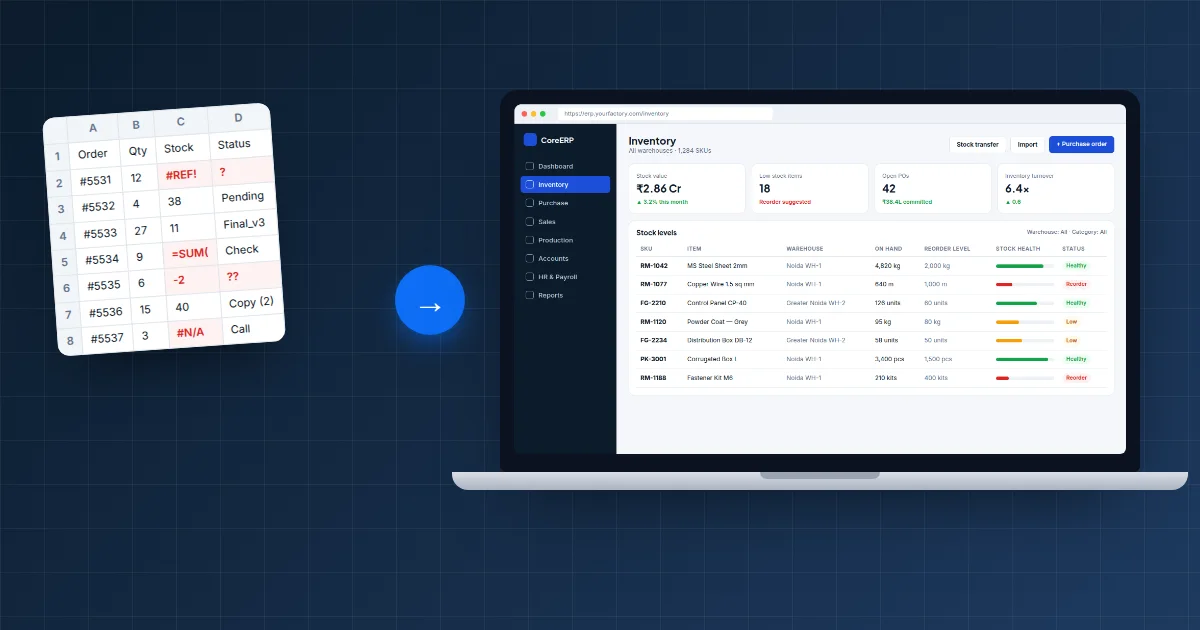
Custom software earns its value when your workflows are specific — the way you price, approve, schedule, fulfil or report is part of what makes your business work. Forcing that into a generic product usually leads to spreadsheets on the side, manual re-entry and frustrated teams.
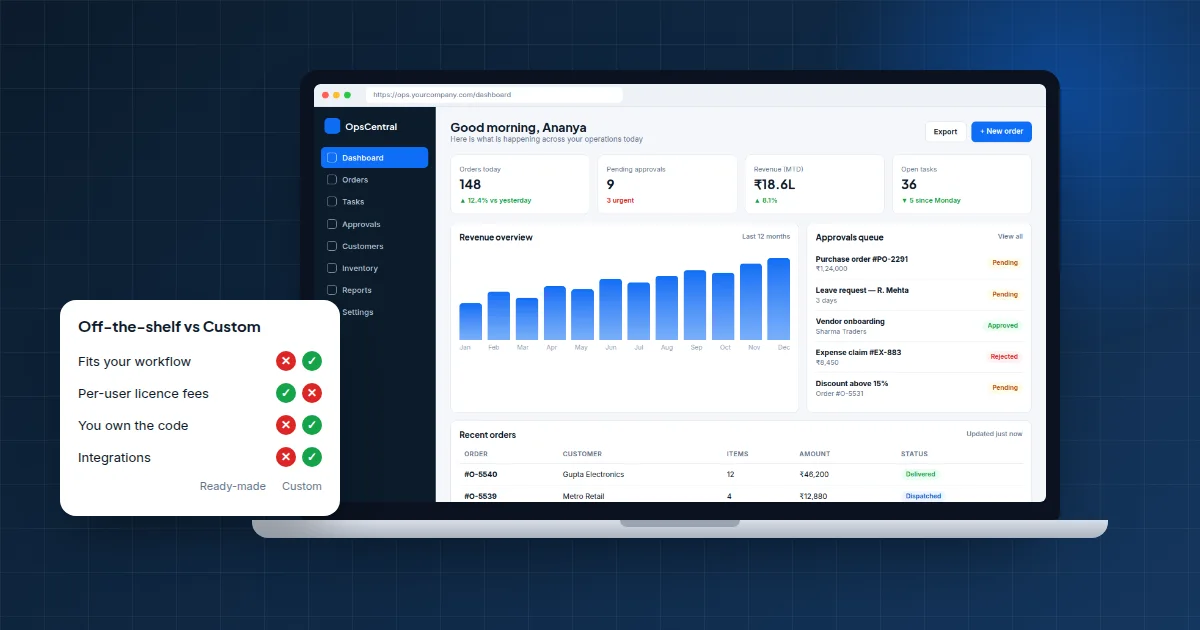
- Your process is a competitive advantage. Software should reinforce it, not flatten it.
- You are paying for many tools that don’t talk to each other. Integration costs and manual reconciliation add up.
- Per-user licences grow faster than value. As teams grow, subscription costs can exceed the cost of owning a system.
- You need control over data, security and performance.
Look at the total cost over time
Comparing the first-year price of a subscription with the build cost of custom software is misleading. A fairer comparison looks at three to five years and includes licences for every user, add-ons, integration work, the time staff spend on workarounds, and the cost of switching later.
Custom software has a higher upfront cost, but you own it, there are no per-user fees, and it can evolve exactly as your business does. Maintenance should be budgeted — typically as an ongoing support plan.
A hybrid approach often works best
Many businesses use off-the-shelf tools for standard functions and build custom software for the processes that are unique to them, connecting everything through APIs. For example, a company might keep its accounting software but build a custom order-management system that syncs invoices to it automatically.
Questions to ask before deciding
- Which of our processes are unique, and which are standard?
- Where do teams currently rely on spreadsheets or manual steps?
- What will this cost over five years, including licences and workarounds?
- Which systems need to share data, and how easily can they?
- What happens if the vendor changes pricing or discontinues features?
Conclusion
Off-the-shelf software is a sensible default for standard functions. When your workflows are specific, critical or growing in complexity, custom software designed around how your business actually operates is usually the better long-term investment. The key is to decide deliberately, based on fit and total cost — not just the price of getting started.
How Omprem Infotech can help
We help businesses decide what to build and what to buy — and then build the parts that need to fit your workflow exactly.
- Custom Software Development — business systems designed around your processes
- ERP Development — inventory, purchase, sales and accounts in one system
- API Development & Integration — connect custom software with the tools you already use
Based in Greater Noida West, we work with businesses across Noida, Delhi NCR and India. Tell us what you are building and we will suggest a practical approach and estimate.