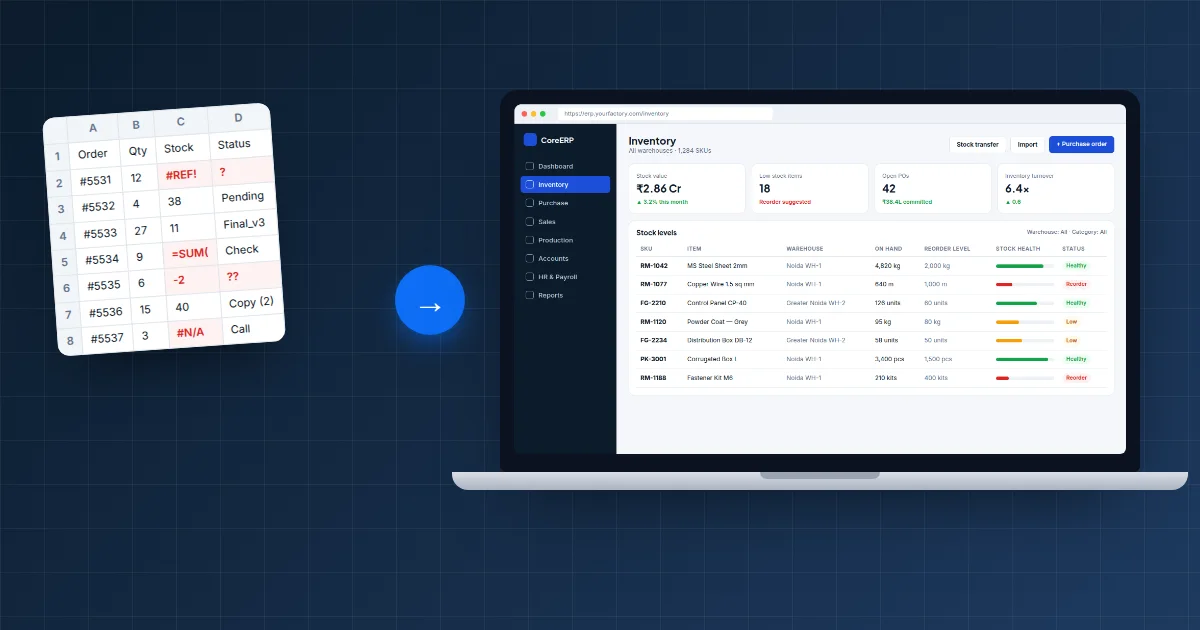
Almost every successful business was once run on spreadsheets. They are flexible, familiar and free. But as orders, people and locations grow, the same spreadsheets that once helped start to slow everything down.
Here are seven signs your business has outgrown them — and a practical path forward.
1. Several versions of the "truth"
When sales, accounts and operations each keep their own copy of the same data, numbers stop matching. Meetings turn into debates about which file is correct instead of decisions about what to do.
2. One person holds everything together
If a single employee is the only one who understands the master sheet and its formulas, your business has a risky single point of failure. Leave, illness or a resignation can bring processes to a halt.
3. Stock and orders do not add up
Overselling, unexpected stock-outs and frequent manual corrections are classic signs that inventory, purchases and sales are not connected in real time.
4. Month-end takes days
If closing the books or preparing an MIS report means copying data between files for days, your team is spending valuable time on work a system can do in seconds.
5. Approvals happen on chat and email
Discounts, purchase orders and expenses approved over messaging apps leave no clear audit trail. It becomes hard to know who approved what, when and why.
6. Customers wait for simple answers
"Where is my order?" or "What is my outstanding balance?" should take seconds to answer. If your team has to search multiple files, customer experience suffers.
7. Errors are becoming expensive
A wrong formula, a deleted row or an outdated price list can lead to real financial losses. As volumes grow, so does the cost of small mistakes.
What to do next
Moving off spreadsheets does not have to be a big-bang project. A practical approach looks like this:
- Map your current process — list what each spreadsheet does, who uses it and where data comes from.
- Start with the biggest bottleneck — often inventory and orders, or leads and follow-ups.
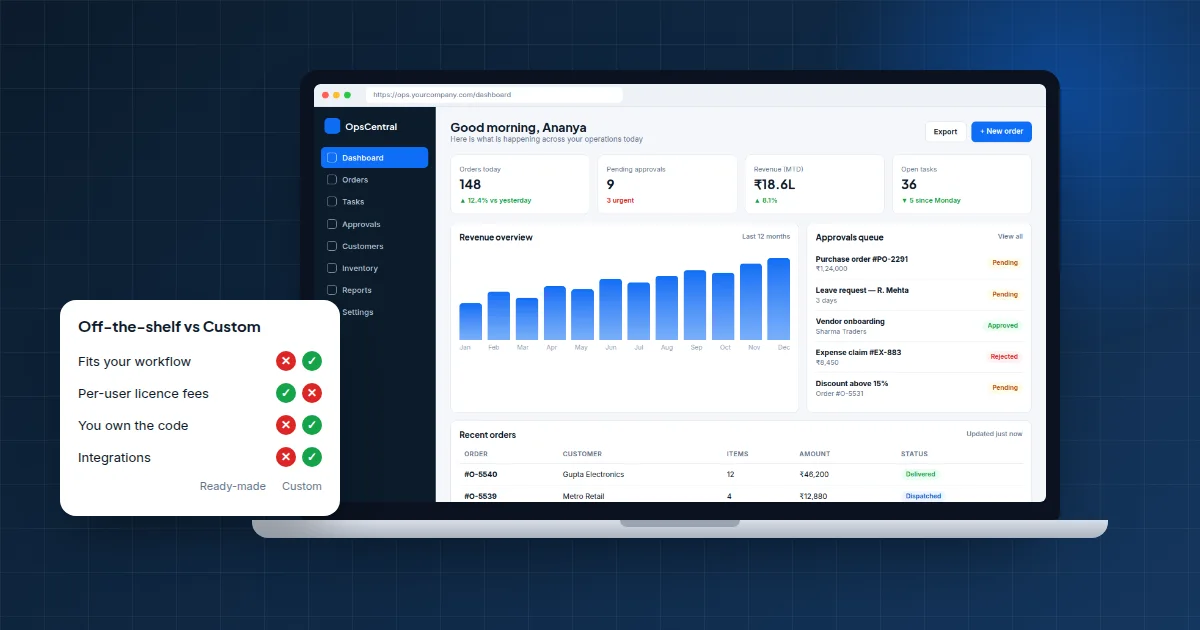
- Choose the right system — an off-the-shelf tool for standard needs, or a custom ERP/CRM when your workflow is specific.
- Migrate data carefully — clean and validate existing records before importing.
- Train the team and roll out in phases — add modules once the first one is working smoothly.
Conclusion
Spreadsheets are a great starting point, not a long-term operating system. If several of these signs sound familiar, it is worth exploring a connected system built around how your business actually works.
How Omprem Infotech can help
We help growing businesses replace spreadsheets with connected systems, one module at a time.
- Custom ERP Development — inventory, purchase, production and accounts
- CRM Development — capture and convert every lead
- Software for SMEs — automation sized for growing businesses
Based in Greater Noida West, we work with businesses across Noida, Delhi NCR and India. Tell us what you are building and we will suggest a practical approach and estimate.