Artificial intelligence has moved from research labs into everyday business tools. Yet many organisations are unsure where to begin, or worry about accuracy, cost and data privacy. The most successful AI projects start small, solve a specific problem and grow from there.
Where AI delivers value today
Knowledge assistants
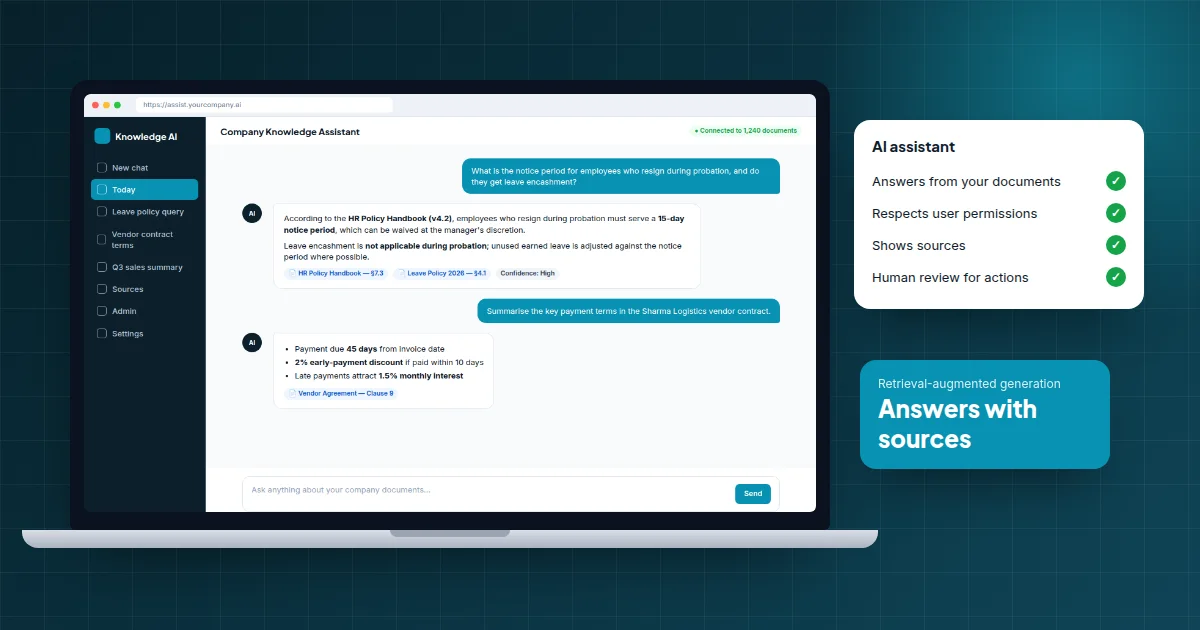
Teams spend a surprising amount of time searching for information in policies, manuals, contracts and past tickets. An AI assistant using retrieval-augmented generation (RAG) searches your approved documents and generates answers grounded in that content, with references to the source.
Document processing
Invoices, purchase orders, forms and contracts contain information that often has to be typed into another system. AI can extract that data, validate it against rules and pass it on for review — turning hours of manual entry into minutes of checking.
Customer support
AI can draft replies, suggest relevant help articles, summarise long conversations and classify incoming requests so they reach the right team quickly.
Classification and routing
Emails, enquiries and tickets can be automatically tagged by topic, urgency or sentiment and routed to the right person or workflow.
Predictions
With enough historical data, machine learning models can forecast demand, score leads or flag unusual transactions for review.
How to choose your first use case
A strong first AI project usually has these characteristics:
- High volume — the task happens often enough that time savings are meaningful.
- Clear inputs and outputs — you can describe what good looks like.
- Tolerance for review — a person can check results while confidence is built.
- Available data — the documents or records the AI needs already exist.
Guardrails that make AI dependable
- Ground answers in your data. Retrieval over approved sources reduces made-up answers.
- Respect permissions. The assistant should only use information the user is allowed to see.
- Keep a human in the loop for actions with financial, legal or customer impact.
- Control what data leaves your systems and choose providers and settings that meet your privacy needs.
- Measure quality and cost continuously, not just at launch.
Integrate AI into existing workflows
AI delivers the most value when it appears inside the tools people already use — the CRM, the helpdesk, the ERP — rather than in a separate application. Integration through APIs lets AI read context and write results back where work happens.
Conclusion
You do not need a large AI programme to see benefits. Choose one repetitive, well-defined task, ground the AI in your own data, add sensible guardrails and measure the result. Once it works, the same foundations can support the next use case.
How Omprem Infotech can help
We build practical AI features with privacy, permissions and human review built in.
- AI Solutions — assistants, document processing and automation
- Digital Transformation — modernise processes step by step
- AI-Powered Application example — what an AI knowledge assistant looks like
Based in Greater Noida West, we work with businesses across Noida, Delhi NCR and India. Tell us what you are building and we will suggest a practical approach and estimate.