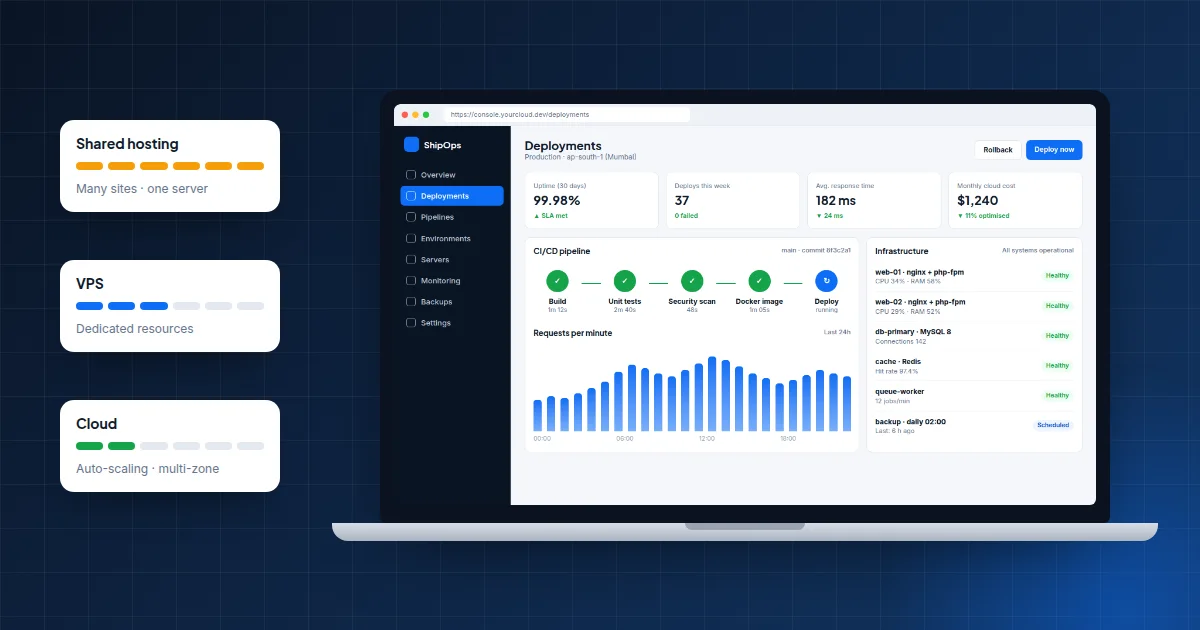
Where your website or application is hosted has a direct impact on how fast it loads, how secure it is and how well it copes with growth. The three common options — shared hosting, a virtual private server (VPS) and cloud platforms — each suit different stages of a business.
Shared hosting
Your site shares a server and its resources with many other customers.
- Good for: small business websites, blogs and low-traffic applications.
- Pros: lowest cost, simple control panel, minimal maintenance.
- Cons: limited performance, restricted server access, and other sites on the same server can affect yours.
VPS (Virtual Private Server)
You get a dedicated slice of a server with guaranteed resources and full control.
- Good for: business applications, ERPs, CRMs and growing websites.
- Pros: predictable performance, full configuration control, good value.
- Cons: requires server management — security updates, backups and monitoring.
Cloud platforms (AWS, Azure, Google Cloud)
Resources are provisioned on demand and can scale automatically.
- Good for: SaaS products, high-traffic platforms and applications with variable load.
- Pros: scalability, high availability, managed databases, storage and global reach.
- Cons: more complex to design and manage; costs need monitoring to avoid surprises.
Security and reliability checklist
Whichever option you choose, make sure you have:
- HTTPS with automatic certificate renewal
- Automated, off-server backups — and tested restores
- Regular operating system and framework updates
- Firewall rules and restricted administrative access
- Uptime and error monitoring with alerts
How to decide
- Start with shared hosting for a simple website with modest traffic.
- Move to a VPS when you run a business application or need more control and consistent performance.
- Choose cloud infrastructure when you need to scale, require high availability, or run a SaaS product.
Conclusion
The best hosting is the one that matches your current needs while leaving room to grow. Many applications begin on a well-managed VPS and move to cloud services as traffic and complexity increase — a transition that is far easier when the application is built with deployment in mind from the start.
How Omprem Infotech can help
We set up, migrate and maintain hosting for websites and applications of every size.
- Cloud Solutions — AWS, Azure and Google Cloud architecture
- Server Deployment — secure, monitored production servers
- DevOps — CI/CD, containers and monitoring
Based in Greater Noida West, we work with businesses across Noida, Delhi NCR and India. Tell us what you are building and we will suggest a practical approach and estimate.